
CrimeStat API
Built a high-performance FastAPI backend that reduced crime data processing time from hours to minutes, now serving regional government operations.
Project Overview
As a Crime Statistician in Police Regional Office 12, I was responsible for processing and categorizing crime statistics data in regional level. What started as a personal Python script to automate tedious Excel work evolved into a full-stack application now deployed on a VPS and serving daily operations.
Live Demo: You can explore the CrimeStat API web application demo here: https://crime-stat-webapp-demo.vercel.app/
The Challenge
Crime data arrives in various Excel formats from different stations and needs to be or extracted in CIRAS as as Excel format:
- Standardized to a consistent format
- Classified according to Philippine legal codes (Revised Penal Code, Special Laws)
- Categorized into Index Crimes (8 Focus Crimes) vs Non-Index Crimes
- Merged and exported for reporting
The manual process was brutal:
- Weekly data: 1-2 hours of manual processing
- Monthly data: 3-4 hours
- Yearly data: 6-8 hours of repetitive Excel work
This wasn't just slow—it was error-prone and soul-crushing.
Solution: From Script to Production API
Phase 1: Python Script
I built a standalone Python script using Pandas to automate the classification logic. It worked, but sharing it with colleagues meant dealing with Python installations and dependencies.
Phase 2: FastAPI Backend
I wrapped the logic in a FastAPI application with proper endpoints, file upload handling, and Excel export. Now anyone could use it through a simple web interface.
Phase 3: Performance Optimization
Pandas struggled with larger datasets. I migrated to Polars, a Rust-based DataFrame library that processes data significantly faster with lower memory usage. Chunked processing handles files of any size.
Phase 4: Production Deployment
Dockerized the application and deployed it to my VPS. Added a Next.js frontend for a clean user interface. The system now handles hundreds of records daily across the region.
Architecture
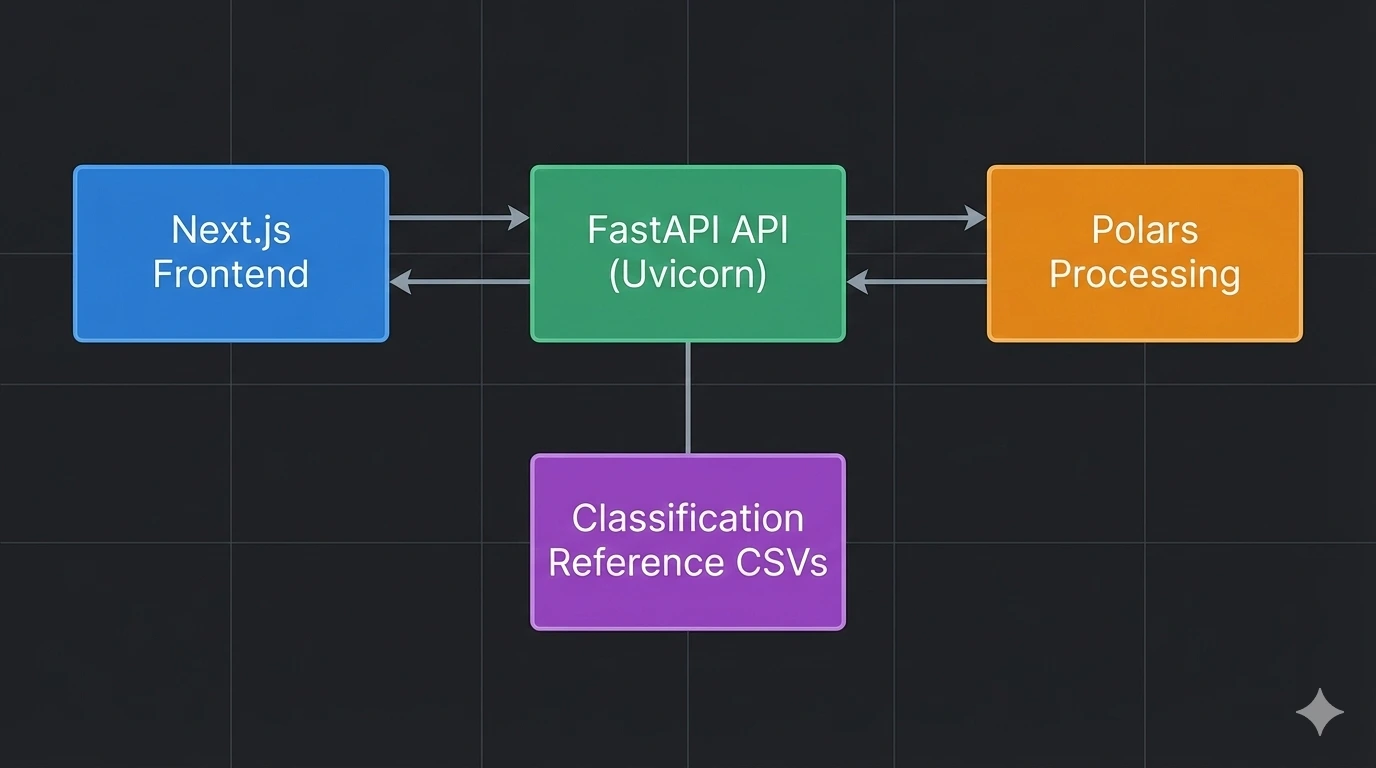
Processing Flow:
- Upload CSV/XLSX files through the API
- Polars reads data in chunks (100k rows per chunk)
- Classification engine matches offenses to categories
- Multiple files merged (vertical or horizontal)
- Export as formatted Excel with proper table styling
Key Features
- Chunked Processing - Handles large datasets without memory issues
- Hot-reload Classifications - Update crime categories without restart
- Multiple Merge Modes - Stack files vertically or join horizontally
- Automatic Cleanup - Temporary files removed after processing
- Health Monitoring - Endpoint for checking source file integrity
- Docker Deployment - 4 Uvicorn workers for concurrent requests
Results
| Data Volume | Before | After |
|---|---|---|
| Weekly | 1-2 hours | < 3 seconds |
| Monthly | 3-4 hours | < 1 minute |
| Yearly | 6-8 hours | < 5 minutes |
Beyond time savings:
- Zero manual classification errors
- Consistent output format every time
- Self-service - colleagues can process their own data
- Audit trail - logged processing for accountability
Technologies Used
- FastAPI - Modern async Python web framework
- Polars - High-performance DataFrame library (Rust-based)
- Uvicorn - ASGI server with worker support
- Docker - Containerized deployment
- Next.js - Frontend interface (separate repo)
- VPS - Self-hosted on personal server
Lessons Learned
-
Start simple, iterate - The first version was a 100-line script. Production version is 500+ lines with proper error handling, but the core logic remained the same.
-
Polars over Pandas - For data processing tasks, Polars is significantly faster. The migration was straightforward and worth every minute.
-
Docker everything - Deploying Python apps with dependencies is painful. Docker made deployment reproducible and simple.
-
Build for yourself first - This started as a tool to make my own job easier. That's why it actually works—I'm the primary user and I feel every friction point.
Interested in similar solutions?
Let's discuss how I can help with your project.